
Fisnik Pula
Somewhere in 2023, a decision got made in a lot of boardrooms at the same time.
It was not announced. It did not come with a press release. It came with a slide deck, a vendor demo, and a number that looked very convincing on a spreadsheet. The number said: AI will cost less than your engineers. So companies started making the swap. Quietly at first. Then not so quietly.
The engineers noticed. Some of them saw it coming. Others found out the way people usually find out about these things: on a Tuesday, in a calendar invite with no context.
I am not writing this to relitigate whether AI is useful. It is. I use it. My team uses it. The engineers at Mikkena use it every day. I am writing this because the story that got sold in those boardrooms was not the whole story, and the missing part is now showing up on invoices.
The Month the Math Stopped Working
Picture an engineer at Uber. December 2025. The company rolls out a new AI coding tool called Claude Code. She tries it. It is genuinely good. Her colleagues try it. Word spreads. By March, 84% of Uber’s 5,000 engineers are using it, which is remarkable adoption by any measure. Usually you fight to get 30% of a company using a new tool. This one spread because it worked.
Then the CTO got the bill.
The entire 2026 AI coding budget, gone. Not stretched. Not over. Gone. Four months into the year, with eight months still to go. Individual engineers had been spending between $500 and $2,000 a month just on tokens. Not salaries. Tokens. The cost of asking questions.
Around the same time, Microsoft sent a memo. Stop using the AI coding tool. Not because it was not working. Because the bills were too large. This is Microsoft. The company that put $13 billion into OpenAI. The company that writes nearly a third of its own code with generative AI. They looked at what their engineers were spending and said: we cannot sustain this.
And then came the line that should be printed on a wall somewhere. Bryan Catanzaro, VP of Applied Deep Learning at Nvidia, the company whose chips are running all of this, told Axios plainly: “For my team, the cost of compute is far beyond the costs of the employees.”
The people selling the shovels are telling you the gold rush math does not work.
A 2024 MIT study put numbers to it: AI is economically cheaper than a human in about 23% of roles. In the other 77%, the human is still the better deal. Gartner now has generative AI in what they call the trough of disillusionment, and they project that a quarter of AI budgets planned for 2026 will quietly roll into 2027, unspent, as pilots die in committee.
None of this means AI is a fraud. It means the business case was built on assumptions that have not held up in production.
Why Telecom Engineering Is Different From a Spreadsheet
There is a version of this AI story where the math eventually works out. Token prices drop, models improve, the unit economics flip. For a lot of industries, that story is probably true. Give it a few years.
Telecom network engineering is not that story.
Think about what a network engineer actually does on a given Tuesday. She is not generating content or summarizing documents. She is managing a live migration of thousands of ports across a carrier network that is actively moving traffic for millions of people. She is writing method-of-procedure documents that she will be held personally accountable for. She is on a call with a vendor escalation team at 2am because something has gone sideways and someone needs to make a judgment call in the next four minutes.
You cannot submit that to a prompt.
Network World analysts will tell you that agentic AI is going to handle more of the routine stuff: incident monitoring, change management, standard configurations. That is true and it is useful. But the same analysis says senior engineers remain indispensable for anything that requires contextual judgment, architecture decisions, or high-stakes interventions.
Here is the paradox nobody talks about: AI-driven network automation actually increases the demand for skilled engineers. The more automated your network gets, the more critical the humans who govern, troubleshoot, and evolve it become. The technology that was supposed to reduce your engineering headcount is creating a more specialized, more expensive version of the same problem.
You do not fix that with a better AI subscription.
The Engineers Who Got Fired Are Not Coming Back at the Same Price
This is the part of the story that rarely makes it into the trade press.
When companies cut engineering teams to fund AI investments, those engineers did not disappear. They went to companies that still valued them, or they went independent, or they moved on to work that paid better. The ones who stayed in network engineering are now in a tighter market than before. The Robert Half 2026 Salary Guide puts a senior network engineer in the US at $110,000 to $202,000 a year in base compensation alone, before you add benefits, employer contributions, and the overhead of keeping someone on your payroll. That number is going up, not down.
So the companies that made the swap are now sitting with two problems. The AI tools cost more than projected. And rehiring the engineers they let go would cost more than it did before.
There is a third option. It does not require choosing between them.
What Actually Works: Humans First, AI as a Tool
The telecom operators getting this right are not the ones who picked a side. They are the ones who asked a different question: what if you started with a lower-cost engineering baseline, and then added AI on top of it?
A Mikkena engineer costs 50 to 70% less than a comparable US hire, according to benchmarks from Statista/DevsData, Playroll, and Robert Half. That engineer also uses AI tools every day. Automation scripting, AI-assisted diagnostics, coding tools when they are useful. The AI spend is a manageable line on a budget that is already optimized, not a runaway cost eating into headcount savings that never materialized.
You get the productivity of AI-augmented engineering. You do not get the invoice that ended Uber’s year in April.
For a team of 10 to 100 engineers, the annual savings versus US-based hiring range from $450K to over $14.6M depending on role mix. That is money that does not vanish in a token pricing adjustment. It is structural. It compounds.
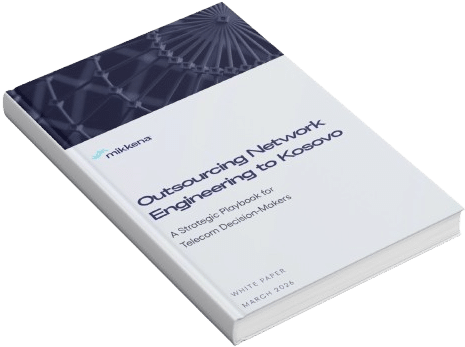
Mikkena has migrated over 75,000 ports for a Tier 1 carrier across all 50 states, completing the program six months ahead of schedule with zero customer-impacting outages. That work was done by engineers. Supported by tooling. Owned by people whose names were on the documents. The full delivery model is here if you want to read it.
A Small Country With a Lot to Prove
I want to tell you something about where Mikkena’s engineers come from, because I think it matters more than the cost numbers.
Kosovo is a young country. Median age of 32, the youngest population in Europe. More than half the country is under 35. It is a place where people grew up watching the world through a window, then decided to build something worth looking at. The tech sector did not emerge from policy papers or investment theses. It emerged from a generation of engineers who saw what was possible and chose to work for it.
Gallup has ranked Kosovo as the most pro-American country in the world, with US approval ratings above 85%, higher than any other nation they survey. Pristina’s main boulevard is named after Bill Clinton. This is not political. It is cultural. It means that when a Kosovo engineer gets on a call with a network operations team in Atlanta or Dallas or Seattle, they are not navigating a cultural gap. They are on the same page before the meeting starts.
This is not the offshoring model most executives have in their heads. That model is built for volume: large teams, well-defined tasks, minimal judgment required, minimal interaction with the client. It works for certain things. Network engineering at Tier 1 carrier level is not one of them.
Kosovo engineers are trained to own outcomes. They ask questions. They push back when something does not make sense. They build relationships with the people on the other end of the line. When something goes wrong at 2am, they call you. That is a different kind of professional than someone whose job is to close tickets.
Ericsson understood this when they chose Kosovo for their first R&D center outside Croatia. The engineers there develop Radio Access processing software for AT&T, T-Mobile, and Vodafone. Ericsson did not go there because it was the cheapest option in Europe. They went there because they found the level of capability they needed.
The Real Story Here
The AI vs. engineers debate was never really about technology. It was about a deeper question that did not get asked out loud in those 2023 boardrooms.
The question was: do we still believe that the people doing this work are worth what we are paying them?
The answer that got written into a lot of strategy decks was: not if we can find a cheaper substitute. And the substitute looked very convincing until it started sending monthly invoices that made the original headcount look like a bargain.
The engineers who lost their jobs in that moment were real people. Some of them had spent years building institutional knowledge that walked out the door with them. Some of them were the ones who knew why the workaround on line 47 of the config existed, and what would happen if someone changed it. That knowledge does not live in a model. It lives in a person, built over time, through experience.
What we have learned in 2026 is that the cost of replacing human judgment with compute is higher than the spreadsheet said. Not because the technology is bad. Because judgment is genuinely expensive to replicate, and the people who have it have other options.
The operators who are going to lead this next phase are the ones who never stopped investing in engineers. Who found smarter ways to structure that investment, not cheaper ways to avoid it. Who understood that the question was never AI or humans. It was always: how do you build a team of humans who can use every tool available to deliver outcomes that a machine alone cannot?
That is the conversation worth having. The other one already had its moment, and the bill is in.
Mikkena Global J.S.C. provides outcome-priced network engineering teams for Tier 1 carriers, ISPs, and global enterprises. 75,000+ ports migrated. Zero customer-impacting outages. mikkena.com