
Keep network engineering in-house when the work is steady, the skill is core to how you compete, and the knowledge must stay inside the company. Outsource it when volume comes in waves, when you need a skill for one program, when change windows need cover around the clock, or when you want the cost of rework to sit with the team that did the work. Most telecom operators and large enterprises end up with a hybrid: design authority and approval in-house, and provisioning, migration, documentation and NOC coverage bought as priced units.
There are three models
The choice is usually framed as in-house against outsourced. In practice there are three models, and the middle one is where many teams get stuck.
In-house: your employees, your process, your cost base.
Staff augmentation: contract engineers billed by the hour, working under your managers. You get capacity quickly, but you still manage the work, and rework is billed to you.
Outsourced units: a partner delivers defined units of work (per order, per circuit, per device) against an SLA, inside your process, with a rework guarantee. You manage the outcome and the partner manages the people.
The comparison
| Dimension | In-house | Staff augmentation | Outsourced units |
|---|---|---|---|
| Cost structure | Fixed salaries plus benefits, recruiting and tools | Hourly rate, time and materials | Price per unit, falling with volume |
| Time to add capacity | Months to hire | Weeks | Two to four weeks through a pilot |
| Scaling down after a program | Layoffs or redeployment | End the contracts | Volume falls, the bill falls |
| Control | Full | Full over people, none over their continuity | Through the SLA, the process and the reporting |
| Who pays for rework | You | You | The partner, under a rework guarantee |
| Knowledge retention | Stays, until people leave | Leaves with the contractor | Runbooks and templates that you own, if the contract says so |
| Coverage of overnight change windows | Night shifts or on-call | Night shifts at a premium | A team whose day shift covers your window |
| Specialist and legacy skills | Hard to justify for short programs | Available, at a premium | Available as a unit, for as long as the program runs |
The US labor market sets the in-house price. The Bureau of Labor Statistics puts the median pay of computer network architects at $134,050 (May 2025 data), Robert Half’s 2026 guide puts senior network engineer base pay at $110,000 to $202,000, and Foote Partners (21 August 2026) found architecture skills carry a 20% cash premium. Hiring is slow as well: 86% of organizations in Cisco’s State of Wireless 2026 report struggle to hire qualified wireless professionals.
Which work fits which model
| Work | Usually in-house | Usually outsourced | Unit to price it by |
|---|---|---|---|
| Network architecture and design authority | Yes | Rarely | Not unitized |
| Provisioning and service activation | Core services | Surges and backlogs | Per order or per port |
| Migrations and decommissioning | Planning and approval | Execution, grooming, documentation | Per circuit, per wire center, per site |
| Design packages and OIC | Standards | Volume design | Per design or per passing |
| NOC and ENOC | Tier 3 escalation, major incidents | L1 to L3 coverage, overnight and weekends | Per device or per ticket, with an MTTR commitment |
| Legacy platforms near retirement | Rarely | Yes, until the switch-off date | Per device, falling as sites close |
The hybrid most teams end up with
Keep the decisions and the design authority. Buy the throughput. The partner works inside your change process, uses your templates and your access model, and reports against the numbers you already track: failed change rate, rework rate, interval and MTTR. When the program ends, the volume and the bill fall together, and the runbooks stay with you.
How to decide
- List the work as units, with monthly volume, for the next 12 months.
- Mark each unit as core (in-house) or throughput (candidate to outsource).
- For throughput units, compare your loaded cost per unit with a partner’s unit price.
- Add the cost of rework and of any dated obligation you could miss.
- Test the answer with a two to four week pilot before you commit the budget.
Where Mikkena fits
Mikkena Global J.S.C. sells network engineering as outsourced units to US telecom operators and enterprises: provisioning, migrations, design packages and NOC coverage, delivered from Pristina, Kosovo, inside the customer’s process. Our engineering cost runs 50 to 70% below fully burdened US cost for comparable senior roles (Robert Half 2026; STIKK 2024), and the rework guarantee puts the cost of a failed change on us. On one US Tier 1 carrier’s migration program, rework went from 28% to 0% and the work finished six months early. Our day shift covers 02:00 to 11:00 Eastern. Send us your 12-month list of units and we will mark the ones we would price.
Sources: US Bureau of Labor Statistics, computer network architects (May 2025 data); Robert Half 2026 Salary Guide; Foote Partners via Network World (21 August 2026); Cisco State of Wireless 2026 via Network World (20 April 2026).
Ask AI about this article
Pick a prompt. Your assistant gets the article and the context.
The three models, how they compare and which work fits each one.
Opens in a new tab with the prompt filled in.

Provisioning fails at the handoffs. Before a circuit, a wave or an Ethernet service carries traffic, the order crosses order management, inventory, design, configuration, test and billing, usually in five or more systems bought in different decades that do not agree on what is in the network. Each handoff is a chance for the record and the network to diverge. A Tier 1 operator runs thousands of these a week, on a legacy stack and a new one at the same time, with fewer people than it had two years ago. The errors are not random. They concentrate in four places, and each one can be closed.
The inventory does not match the network
Most fallout starts before anyone types a command. The inventory says a port is free and it is not. The circuit ID on the order does not exist on the device, or exists under a name left over from a migration nobody documented. Design is done against the record, configuration is pushed against the network, and the difference surfaces at test, with the customer already holding a date.
On a large network the gap between record and reality is measured in percent, and every percent is a queue of orders that fall out of the automated flow and come back as manual work. The fix is unglamorous. Reconcile before you provision. Make the device audit the first step of the order and treat a mismatch as a stop.
Configuration is typed by hand under volume
A senior engineer configuring a PE router at two in the morning from a template is reliable. The same engineer configuring the fifth device of the night from memory, because the template did not cover that vendor’s syntax, is where the typo lives. Manual configuration fails on volume, and volume is what a Tier 1 operator has more of than anyone.
Automation takes the repeatable part. It does not take the exception: the legacy device the script does not know, the order that changed after design, the customer with a non-standard handoff. Those still need an engineer who knows the network, and that engineer is now the scarce resource.
The order changed after the design
Sales amends the bandwidth. The customer moves the demarcation point. A site survey finds no fiber in the building. A wholesale partner changes the NNI. The design approved on Monday is provisioned on Thursday against a different order, and nobody re-runs the design step because the ticket number is the same. In a mature process the order and the design carry a version, and the pre-check compares them. In most processes the pre-check is a person remembering.
The activation is treated as a formality
An activation is a change. It deserves what a core migration gets: a method of procedure, a pre-check, a go or no-go, a named rollback owner and a post-check. On many provisioning floors it gets none of that, because the change is small and there are 300 more behind it. Small changes are where the outages come from. When one fails, the operator pays twice, once for the rework and once for the customer who was promised a date.
Why it is harder at Tier 1 scale in 2026
Four things are true at once for a US Tier 1 operator this year.
The headcount is smaller. T-Mobile cut 4,671 roles in the first half of 2026 (Fierce Network, 12 August 2026). AT&T’s $4 billion cost program to 2028 names “vendor rationalization” as one of its levers (Q1 2026 call, 22 April 2026). The order queue did not shrink with the org chart.
Two networks run in parallel. AT&T’s first FCC-granted copper discontinuance takes effect on 15 November 2026 (auto-granted 13 January 2026), while fiber and wave orders keep growing. The same desk carries a TDM disconnect and a 400G wave on the same day, in different systems, with different fallout rules.
The tools multiply. EMA’s Network Management Megatrends 2026 survey (22 April 2026, 352 respondents) found only 31% of organizations “completely successful” with their network operations strategy and put alert noise and tool sprawl among the top problems. Every extra tool is another place for the record to disagree with the network.
The senior engineers are being pulled toward design. Foote Partners reported on 21 August 2026, from 5,137 employers, that automation is devaluing “routine network operations work, including monitoring, basic troubleshooting, and configuration changes” while raising the market value of design and architecture skills. The people who used to catch the provisioning exception are being promoted away from it.
What error-free means in writing
“Error-free” is a target. Five numbers make it a contract. Ask for each of them, defined, with the period, from whoever runs your provisioning, in-house or not.
| Number | Definition to agree | What it tells you |
|---|---|---|
| Order fallout rate | Orders that leave the automated flow for manual handling, divided by orders received, per month | Where inventory and process disagree |
| Rework rate | Activations touched again after completion, divided by activations completed | Whether the change window was real |
| Interval | Order received to service tested, by product, median and 90th percentile | What the customer is actually being promised |
| Post-deployment fixes | Tickets opened against a service within 30 days of activation | The quality of the design and test steps |
| Cost of a failed change | Who pays for the rework, written into the SOW | Whether the vendor has a reason to get it right the first time |
What the teams that get it right do
- They work inside the operator’s process, with the operator’s templates and go or no-go criteria. The customer’s process is the process.
- They put a dependency list on the first page of every MOP, even for one activation, because a payment, a video call or an alarm circuit is on the other end of the port.
- They reconcile inventory as step one and stop on a mismatch.
- They automate what repeats and keep a senior engineer on what does not.
- They write the handover between shifts, so the engineer at 08:00 in one time zone does not rediscover what the engineer at 02:00 in another already found.
- They put the five numbers above in the contract, with the cost of a failed change on the party that ran it.
Where Mikkena fits
Mikkena Global J.S.C. runs provisioning and service activation for Tier 1 operators from Pristina, Kosovo, inside the operator’s own process and change calendar. We publish a 99.99% provisioning SLA and price the work per order or per port with a rework guarantee, so the cost of a failed change lands on us. On one North American MSO’s network our engineers delivered 91,031 network designs with 85% fewer post-deployment fixes and cut restoration time from 8.5 hours to 3.4 (mikkena.com/case-study). On one US Tier 1 carrier’s migration program, rework went from 28% to 0%. Our day shift covers midnight to 11:00 Eastern, which is the change window most US operators use. If you want to see your fallout and rework rates as a unit price, send us one month of order volume for one product line. Pricing it takes us a day.
Sources: Fierce Network (12 August 2026); Broadband Breakfast on AT&T copper discontinuance (13 January 2026); EMA, Network Management Megatrends 2026 (22 April 2026); Foote Partners via Network World (21 August 2026).
Ask AI about this article
Pick a prompt. Your assistant gets the article and the context.
The argument, the four places errors concentrate and the five numbers to put in a contract.
Opens in a new tab with the prompt filled in.
Four kinds of vendor will run a legacy voice platform for you in 2026, and they do four different jobs. Platform vendors, Ribbon and Alianza (which owns Metaswitch) among them, support and replace the switches. Signaling service bureaus such as TNS, Syniverse and BICS carry SS7 for you as a hosted, managed service. Large managed network services firms such as Tech Mahindra, Prodapt, HCLTech, Cyient and Infinite run NOC operations across the whole estate, legacy voice included. Specialist engineering squads such as Mikkena run the TDM and SS7 NOC you already own, per device or per ticket, until the switch-off date. Which one fits depends on whether you are keeping the platform, replacing it, or running it down to a date.
Why the question is being asked now
The FCC’s order of 26 March 2026 cut the automatic grant period for discontinuance applications to 31 days and preempted state rules that delay it. AT&T’s first FCC-granted copper discontinuance takes effect on 15 November 2026 (auto-granted 13 January 2026). AT&T expects “a couple of hundred wire centers” to have zero customers by the end of this year (Q2 2026 call, 22 July 2026), and its legacy service revenue fell 26% year over year in the same quarter. In the UK, BT’s PSTN switch-off is fixed for 31 January 2027 (BT, 22 May 2026).
The platforms are aging on the same clock. Ribbon’s own TDM switch retirement calculator assumes a 25-year design life (ribboncommunications.com, accessed 21 September 2026), which puts most of the installed base past it. Microsoft laid off most of the Metaswitch team in June 2024 (Light Reading, 13 June 2024; Alianza, 18 June 2024) and sold the business to Alianza, which completed the purchase on 4 March 2025 and has committed to keep supporting the existing products.
The staffing picture is the hard part. The last two to four years of a TDM or SS7 platform are the hardest years to staff, because nobody builds a career on the last DMS in the region and the engineers who know it are retiring or being moved to fiber. A NOC contract for that period is not a modernization program. It is insurance against the one engineer who knows the switch leaving before the date.
The four categories
| Category | Examples | What they run for you | Fits when |
|---|---|---|---|
| Platform vendors |
|
Support on the switch, replacement call controllers and gateways, professional services for the migration | You are replacing the platform, or need OEM support to the end |
| Signaling service bureaus |
|
SS7 as a hosted, managed service: STPs, SIGTRAN conversion, routing and number databases | You want to stop owning STPs and signaling links |
| Managed network services firms |
|
Multi-year NOC and network operations across the estate, legacy voice one line among many | You are outsourcing the whole NOC |
| Specialist engineering squads |
|
L1 to L3 NOC on the TDM and SS7 platforms you own, per device or per ticket, to the switch-off date | You are running the platform down to a date and want the cost to fall with it |
Platform vendors
Ribbon Communications holds the Nortel DMS lineage through Genband and sells the C15 and C20 call controllers and the G6 media gateway as the replacement path, with STP and Diameter signaling software that runs as an appliance, on COTS hardware or in a cloud. On 9 September 2026 Ribbon and TNS announced a managed, cloud-based voice service built on Ribbon’s application server, SBC and PSX, positioned as a path off legacy switches without a full replacement. Alianza completed its acquisition of Metaswitch from Microsoft on 4 March 2025, serves more than 1,000 service providers, and says it will continue to support the existing Metaswitch products while it integrates them. Nokia holds the 5ESS lineage through Lucent and Alcatel-Lucent and still hosts the documentation; get the support end date in writing.
None of them runs your NOC. Their services teams migrate you; until then, your people watch the platform.
Signaling service bureaus
TNS sells SS7 ISUP and TCAP signaling as a managed service on its own network, a managed conversion from SS7 to SIGTRAN that “reduces costly time-division multiplexing (TDM) circuits”, and routing, number portability data and access to every toll-free number in the United States and Canada (communications.tnsi.com, accessed 21 September 2026). Syniverse and BICS do the equivalent for mobile signaling and IPX; the two announced a 5G standalone roaming partnership on 3 March 2026, with Syniverse citing more than 830 connections worldwide.
Put your signaling on a bureau and you have removed the STPs from your estate. The switches, the trunks and the alarms behind them are still yours, so the NOC question remains.
Managed network services firms
Prodapt (6,000+ staff; AT&T, Windstream, Ziply, Brightspeed and Zayo are among the customers named on its site), Tech Mahindra (communications is about 32% of a $1.66 billion quarter, results of 17 July 2026), HCLTech (a six-year, $2.1 billion managed network services contract with Verizon Business, August 2023), Cyient (15,000+ staff) and Infinite (a telecom NOC covering mobile core, IMS and fixed voice, monitoring 45,000 devices and handling 220,000 tickets a year by its own count) will take the whole NOC, legacy voice included. These are multi-year managed services or time-and-materials contracts, and the legacy platform is one line in a wide scope.
Two things sort this category quickly: the names of the people on the account who have worked a DMS or a 5ESS this year, and whether the monthly fee falls when the wire centers reach zero.
Specialist engineering squads
Mikkena Global J.S.C. lists legacy TDM and SS7 NOC operations as a service line and works the other way round from the three categories above. We run the platforms you already own; selling a replacement is somebody else’s job. L1 to L3 coverage around the clock from Pristina, an MTTR commitment in the contract, priced per device or per ticket, with a price that steps down as wire centers close. Our day shift covers 02:00 to 11:00 Eastern, where most US change windows sit. ISO 27001 and ISO 9001, with the access model for customer data agreed in writing before an engineer touches a platform. On one North American MSO’s network our NOC cut restoration time from 8.5 hours to 3.4 (mikkena.com/case-study).
How to choose
Decide what you are doing with the platform: keeping it past 2030, replacing it, or running it down to a date. Then ask every vendor on the list for five things in writing.
- The party that holds the support contract on the switch after the OEM’s end-of-support date, and the price and lead time of a spare card.
- The party that carries the SS7 STPs and links, and the cutover plan if that changes.
- The MTTR commitment, in hours, and the contractual remedy if the SLA is missed.
- The unit of charge, per device, per ticket or per hour, and whether it falls as lines migrate.
- The access model for customer data for engineers outside the US, and who signs it off.
Our answer
Our answer to the question in the title is narrow on purpose. If you are replacing the platform, talk to Ribbon or Alianza and to a signaling bureau. If you are running it down to 15 November 2026, 31 January 2027 or a date of your own, we will price the NOC for one wire center cluster or one exchange group, per device, with the MTTR in writing. A one-page scope takes us a day.
Sources: FCC order 26-19 (26 March 2026); Broadband Breakfast on AT&T copper discontinuance (13 January 2026); Alianza on the Metaswitch acquisition (4 March 2025). Vendor figures are from each company’s own published material, as dated in the text.
Ask AI about this article
Pick a prompt. Your assistant gets the article and the context.
Why the question is urgent, the four kinds of vendor and the five things to ask.
Opens in a new tab with the prompt filled in.

Some things were simply never meant to work alone.
A handshake needs two hands. A conversation needs someone to speak and someone to listen. A bridge needs two sides to connect. A question needs an answer. A promise needs someone to make it and someone willing to trust it.
Even the word connection implies that there is something on the other side.
The more you think about it, the more you realize that much of what moves the world forward happens when two sides come together.
Telecom is no different.
In fact, for an industry built entirely around connecting people, places and technology, we sometimes spend surprisingly little time talking about one of the connections that matters most: the one between the people building it.
That is the idea behind It Takes Two to Telecom.
Telecom Has Always Been a Partnership Business
Look behind any successful network deployment and you will find far more than infrastructure.
There are engineers solving problems in the field. Project managers keeping hundreds of moving pieces aligned. Technicians working against deadlines. Operations teams responding when something changes. Customers expecting the network to work without ever having to think about what it took to make that possible.
And somewhere between all of those moving parts are partnerships.
The industry often calls them vendor relationships. We think that description falls short.
A vendor completes a scope of work.
A partner understands what the work means to the business around it.
There is a difference.
When timelines change, a partner adjusts. When something unexpected happens in the field, a partner helps solve it rather than pointing at the original scope. When pressure increases, a partner does not disappear behind another process or another layer of communication.
They show up.
Because successful telecom work is rarely about one company handing something off to another. It is about two teams moving toward the same outcome.
The Network May Be Technical. Trust Is Human.
Telecom is filled with extraordinary technology. Fiber, wireless infrastructure, data centers, network equipment and the systems connecting them continue to become more sophisticated.
But technology does not eliminate the need for trust.
If anything, the complexity of modern networks makes trust more important.
You need to know that the people on the other side of the project understand the standard. That they will communicate when something changes. That they can operate at the pace the project requires. That when a problem appears, their first instinct is to help solve it.
That kind of confidence cannot be written into a specification.
It is built over time.
Project by project. Market by market. Conversation by conversation.
And when it exists, something changes. Two separate companies stop operating like two separate companies. The lines between “your team” and “our team” begin to disappear.
The work simply becomes the work we need to get done.
That is partnership.
One Network. Two Sides of the Same Goal.
The strongest partnerships are not built because both companies are identical.
They work because each side brings something the other needs.
One side may understand the network from the inside. The other brings the people, expertise and field experience needed to execute it.
One brings the challenge. The other brings another perspective.
One knows where the network needs to go. The other helps build the path to get there.
Different responsibilities. Same destination.
It is the same principle behind so many things that work in everyday life. Two hands complete a handshake. Two ends make a connection. Two sides allow a bridge to do what it was built to do.
Neither side becomes less important because the other exists.
They become more capable because they work together.
Partnership Matters Most When Things Don’t Go According to Plan
Anyone who has spent enough time in telecom knows that perfect plans rarely stay perfect.
Conditions change. Timelines move. Requirements evolve. A deployment that looked straightforward on paper becomes something entirely different once work begins in the field.
That is where the difference between a transactional vendor and a true partner becomes obvious.
A transactional relationship works best when everything goes according to plan.
A partnership proves itself when it doesn’t.
The question stops being, “Whose problem is this?”
It becomes, “How do we solve it?”
That shift may sound small, but across a large network, it changes everything.
It means fewer walls between teams. Faster decisions. Better communication. More accountability. And ultimately, a stronger operation.
You stop spending energy managing the relationship and start spending it moving the work forward.
Why Having the Right Partner Matters
There is another reason we believe so strongly in this philosophy.
Networks are too important to depend on relationships that only work when everything is easy.
Scale requires resilience, not only in infrastructure but in the ecosystem supporting it.
Having the right partners creates options. It gives teams additional expertise, capacity and perspective when they need it. It reduces dependency on a single way of doing things and creates an organization that can respond when circumstances change.
The objective is not to add complexity.
It is the opposite.
The right partnership should make a complicated business easier to operate.
It should give you someone else who understands the problem before you have to explain every detail. Someone who knows the standards. Someone who can step in when capacity is stretched. Someone who treats the outcome as seriously as you do.
Because the best partnerships do not create more work to manage.
They create more capability.
What “It Takes Two to Telecom” Means at Mikkena
For us, It Takes Two to Telecom is more than a campaign line.
It describes the kind of company we have always wanted Mikkena to be.
We believe our job is not simply to execute work and move on to the next project. Our job is to understand what our partners are trying to accomplish and become part of the team responsible for making it happen.
That means listening before acting.
It means communicating clearly.
It means understanding that what looks like one project on our side may be one piece of a much larger commitment on our partner’s side.
It means taking ownership.
And above all, it means showing up.
Today, Mikkena’s team of more than 150 engineers operates across all 50 states, supporting some of the largest organizations in telecom. The scale has changed over the years. The principle behind how we work has not.
Networks are built through connections.
So are companies.
So are partnerships.
So is trust.
And after everything we have learned building alongside our partners, we keep coming back to the same simple truth:
It takes two hands to shake.
Two sides to build trust.
And sometimes, it really does Take Two to Telecom.
Ask AI about this article
Pick a prompt. Your assistant gets the article and the context.
The idea behind It Takes Two to Telecom and what it means in practice.
Opens in a new tab with the prompt filled in.
For four years, BEAD was a paperwork program. Allocation formulas, challenge processes, subgrantee selection, final proposals. The organizations that did well were the ones with strong grant writers and patient lawyers.
That phase is over. All 56 states and territories submitted Final Proposals, 53 have NTIA approval, and the first BEAD-funded projects are entering construction this summer. Most build activity runs 2026 through 2028, with builds in the largest states, Texas among them, stretching to 2030.
The skill that wins a subgrant and the skill that delivers one are not the same skill. A lot of the awards went to regional ISPs, electric cooperatives, and municipal utilities who have built networks before, but not at this scale, not on this timeline, and never under this compliance regime.
Here is what changes now, and what to check before your first shovel.
The compliance layer is the part that surprises people
BEAD is not a normal build. Funded projects carry obligations that most regional operators have never had to document:
Build America, Buy America sourcing. Domestic content requirements on materials, with documentation to prove it, in a market where fiber and optical components are already supply-constrained by AI data center demand. Sourcing decisions that used to be a procurement conversation are now a compliance conversation, and a waiver request has a timeline attached.
The letter of credit. Before signing a subgrant agreement, awardees post an irrevocable standby letter of credit or a surety bond against the subaward. It can step down as take rates hit thresholds, but for a small operator it ties up real capital at exactly the moment construction costs peak, and the paperwork to reduce it is yours to drive.
Labor compliance, self-certified. The 2025 restructuring removed the workforce development scoring from the application phase, but subgrantees now self-certify compliance with federal labor and employment law. Self-certification is not less exposure, it is exposure with your signature on it and no state reviewer catching problems before they become findings.
Detailed and ongoing reporting. Location-level progress against the specific broadband serviceable locations in your award. This is not a quarterly narrative. It is address-level data, and it has to reconcile.
The 25 percent non-federal match. Most awards require it, and it has to be documented and drawn correctly.
None of these are technically hard. All of them consume engineering and program hours that were not in the original staffing model, because in a normal build they do not exist.
The engineering bottleneck nobody priced
The bigger risk is more mundane.
You won an award to serve several thousand locations across a service territory that was chosen precisely because nobody wanted to build there. That means low density, difficult terrain, long drops, and permitting across multiple jurisdictions with no shared process. Every one of those factors multiplies the engineering hours per passing relative to a suburban overbuild.
Meanwhile, the same team doing that design work is still running your existing network, which did not get smaller when the award came through.
And you are hiring into the tightest network engineering market on record. Enterprise Management Associates put the share of organizations struggling to hire and retain network engineers at 52 percent this year, up from 26 percent in 2022. Every BEAD subgrantee in your state is recruiting from the same pool at the same time, along with every hyperscaler building in the region.
The slip is not dramatic. Design falls two months behind, permitting starts late because permits follow design, construction crews are scheduled against dates that design cannot support, and you pay crew standby while your reporting shows locations passed against a milestone you are going to miss.
A readiness checklist
Run this before construction, not after the first slip.
1. Hours, not headcount, split by where the work happens. Model the total engineering hours the award requires, then divide them into work that requires someone on site (OSP design walkouts, splice supervision, field validation, construction oversight) and work that does not (transport and IP design, configuration and turn-up, service validation, routing policy, monitoring design, documentation, reporting). A single blended estimate hides the shortage and, worse, hides the fact that these two categories have completely different fill options.
2. Your actual available capacity. Take current team hours and subtract everything committed to running the existing network. In most organizations that leaves 5 to 20 percent, not the number the org chart implies.
3. Permitting lead times by jurisdiction, mapped to design completion dates. Permits cannot start before design finishes. If you have twelve municipalities and one designer, sequence it now.
4. Make-ready and pole attachment exposure. This is where schedules die. Pole attachment regulation is itself contested right now, with NARUC’s Telecommunications Committee passing a resolution in July arguing the FCC lacks authority to preempt state pole attachment rules over policy disagreements. Assume the process is slower than your plan.
5. Material sourcing against BABA, with lead times. Fiber and high-density optical supply is tight because AI data center demand overtook telecom as the primary growth driver for optical cable this year. Order windows that were comfortable in 2023 are not comfortable now.
6. Documentation ownership, named. As-builts are the first deliverable to slip and the most expensive to reconstruct. Someone’s name goes on this or it will not happen.
7. Reporting reconciliation. Confirm your location-level progress data can actually reconcile to the BSL list in your award. If your field systems and your award data do not share a location identifier, fix that before you have 4,000 records.
8. Surge plan for the off-site work, defined in advance. Field crews you will source locally, and that market is what it is. The off-site engineering load is the part you have options on, and it is the part that quietly consumes your senior local people if you do not plan for it. Decide now, not in month four at spot rates with no time to onboard anyone.
The part worth deciding early
Item eight is the one that separates programs that hold their dates from programs that do not, for a reason that is easy to miss.
The instinct during a build is to point every available engineer at the field, because the field is visibly behind. What actually happens is the opposite. The logical work does not go away, so your senior local engineers end up splitting their week between a construction site and a config backlog, doing neither well, and the design queue becomes the thing that holds up permitting, which holds up crews.
Spot contract engineering does not fix it either. A contractor who arrives in month four does not know your network, your standards, or your territory. They spend six weeks learning on your clock and then leave with the context. Repeat that three times over a two-year build and you have paid a premium for discontinuity.
The alternative is to establish the off-site capacity before you need it, with a team that learns your standards during the planning phase and is already productive when the backlog appears.
That is what Mikkena provides. Network engineering from our team in Kosovo, covering the logical layer: design and OIC engineering, provisioning and service activation, access and aggregation, Metro Ethernet and MPLS transport, NOC and ENOC operations, and the migration engineering that moves services onto new infrastructure without outages. We do not send crews. What we do is make sure the people who can be on site are actually on site, instead of clearing a config queue at 9 p.m.
Source: NTIA, BEAD program.
Ask AI about this article
Pick a prompt. Your assistant gets the article and the context.
Why BEAD awards slip after the paperwork, the compliance layer and the eight point checklist.
Opens in a new tab with the prompt filled in.
How to Cut Network Engineering Costs by Up to 70%
What 250 years of not depending on anyone taught us about building networks that don’t fail
In July of 1776, a group of men in Philadelphia signed a document that boiled down to one very simple, very stubborn idea: we’re done depending on someone else to keep the lights on.
That’s it. That’s the whole thing, stripped of the powdered wigs and the poetry. A colony deciding it would rather build its own systems, take its own risks, and answer to no one else’s failures, than keep relying on infrastructure it didn’t control.
250 years later, we’re still building on that same instinct. We just do it with fiber instead of muskets.
The network is the new frontier
Every generation has its version of “infrastructure.” In 1776 it was roads, ports, and printing presses. In the 1860s it was the telegraph. In the 1950s it was the interstate highway system. Today, it’s the network: the invisible layer of fiber, switches, towers, and engineers that decides whether a hospital in Ohio can pull up a patient’s chart, whether a bank in Atlanta can process a transaction, whether a call to 911 actually connects.
Nobody thinks about it until it breaks. That’s kind of the point. Good infrastructure is supposed to disappear into the background. The founders wanted a country that could stand on its own without leaning on a crown 3,000 miles away. Today, telecom operators want networks that can stand on their own without leaning on a single point of failure.
Same instinct. Different century.
What “independence” actually means in a network
It’s tempting to treat “independence” as a nice word for the history books. But in our world, independence is a design principle, not a sentiment. It shows up in very specific, very unglamorous ways:
Redundant paths. No network worth trusting has just one way for data to get from A to B. If a backhoe cuts a fiber line in Ohio (and it will, backhoes are undefeated), traffic needs somewhere else to go. Independence means never having your entire operation hostage to one buried cable.
Multi-vendor resilience. Depending on a single supplier for everything is just a slower version of depending on a single king. When one vendor has a bad quarter, a bad update, or a bad day, the whole network shouldn’t feel it.
24/7 monitoring. Problems don’t wait for business hours, and neither did the men debating independence into the night by candlelight. A network that’s only watched from 9 to 5 isn’t really being watched at all.
Proactive maintenance. The difference between a minor fix and a 2am outage call is usually about three weeks of somebody paying attention before anyone else noticed there was a problem.
None of this is inspiring in the way fireworks are inspiring. But it’s the same underlying bet: build something that can take a hit and keep functioning, instead of something that collapses the moment it’s left alone.
The uncomfortable truth about most networks
Here’s the part that doesn’t make it onto the postcard.
Most networks aren’t actually independent. They look fine, right up until the moment they don’t. A single vendor goes down. A single path gets cut. A single engineer who understood the whole system quietly leaves the company (or gets let go to make room in the budget for an AI tool that can’t actually do their job), and takes the tribal knowledge with them. And suddenly the network that looked so solid turns out to have been leaning on one thing the whole time.
Independence isn’t a status you declare once and keep forever. It’s something you have to keep building, on purpose, on a Tuesday, long after the fireworks are over. The Declaration didn’t win the war. It just stated the intention. The next eight years were the actual work: unglamorous, expensive, and mostly invisible to the people it was protecting.
That’s network engineering too. Nobody throws a parade for a redundant fiber path that quietly did its job during a storm. Nobody writes a folk song about the engineer who caught a failing switch three weeks before it would’ve taken down a regional carrier. But that’s the work. That’s always been the work.
Where Kosovo fits into an American story
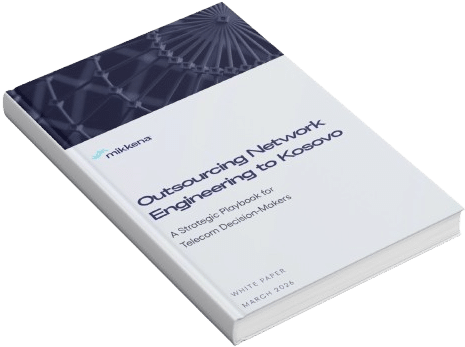
There’s a detail in this that’s easy to miss if you’re not looking for it: a meaningful amount of the engineering keeping American Tier 1 networks independent right now isn’t happening in America at all. It’s happening in Prishtina, on teams built specifically to give US carriers the redundancy, the 24/7 coverage, and the bench depth they can’t always staff at home. We wrote a whole whitepaper on why that model works, if you want the longer version.
There’s something fitting about that. Kosovo is one of the most openly pro-American countries in the world, not as a talking point, but as lived history: the statues, the street names, the gratitude that’s older than most of the engineers now working night shifts to keep a Comcast VNOC running smoothly. It’s a country that understands, in its own bones, what it means to want to build something independent and have someone show up to help you do it.
250 years ago, America decided it didn’t want to depend on anyone else to keep its own lights on. Today, some of the people helping keep America’s lights on happen to be 5,000 miles away, in a country that’s never forgotten what that kind of help meant when it needed it too.
This week, that story got a trophy
Here’s where this stops being a metaphor.
This week, the American Chamber of Commerce in Kosovo and the US Embassy in Kosovo recognized Mikkena Global J.S.C. as one of Kosovo’s two largest exporters to the United States.
Read that again. A network engineering company, built from Prishtina, keeping American telecom infrastructure independent, was just named one of the top two reasons goods and services flow from Kosovo to the US at all.
Fisnik Pula, our CEO, put it better than we could: when the question kept coming back to “why would a US operator trust a team from Kosovo with their network infrastructure,” the answer was never an argument. It was just work. Every single day, until the question stopped getting asked.
That’s the whole philosophy of this post, standing on a stage, holding a trophy with a “250” on it, on the week America turns the same number.
Nobody builds independence with a speech. You build it one uptime report, one caught failure, one unremarkable Tuesday at a time, for long enough that eventually someone hands you an award and says: this, actually, is one of the biggest things holding the relationship together.
Kosovo exports talent. It always has. This week, that got put on paper.
Happy 250th
Here’s to uptime. Here’s to redundancy. Here’s to never finding out the hard way which parts of your network were quietly depending on just one thing all along.
And here’s to the people, wherever they’re sitting, who make sure you never have to find out.
Ask AI about this article
Pick a prompt. Your assistant gets the article and the context.
The award, what independence means in a network and where Kosovo fits.
Opens in a new tab with the prompt filled in.
Somewhere in 2023, a decision got made in a lot of boardrooms at the same time.
It was not announced. It did not come with a press release. It came with a slide deck, a vendor demo, and a number that looked very convincing on a spreadsheet. The number said: AI will cost less than your engineers. So companies started making the swap. Quietly at first. Then not so quietly.
The engineers noticed. Some of them saw it coming. Others found out the way people usually find out about these things: on a Tuesday, in a calendar invite with no context.
I am not writing this to relitigate whether AI is useful. It is. I use it. My team uses it. The engineers at Mikkena use it every day. I am writing this because the story that got sold in those boardrooms was not the whole story, and the missing part is now showing up on invoices.
The Month the Math Stopped Working
Picture an engineer at Uber. December 2025. The company rolls out a new AI coding tool called Claude Code. She tries it. It is genuinely good. Her colleagues try it. Word spreads. By March, 84% of Uber’s 5,000 engineers are using it, which is remarkable adoption by any measure. Usually you fight to get 30% of a company using a new tool. This one spread because it worked.
Then the CTO got the bill.
The entire 2026 AI coding budget, gone. Not stretched. Not over. Gone. Four months into the year, with eight months still to go. Individual engineers had been spending between $500 and $2,000 a month just on tokens. Not salaries. Tokens. The cost of asking questions.
Around the same time, Microsoft sent a memo. Stop using the AI coding tool. Not because it was not working. Because the bills were too large. This is Microsoft. The company that put $13 billion into OpenAI. The company that writes nearly a third of its own code with generative AI. They looked at what their engineers were spending and said: we cannot sustain this.
And then came the line that should be printed on a wall somewhere. Bryan Catanzaro, VP of Applied Deep Learning at Nvidia, the company whose chips are running all of this, told Axios plainly: “For my team, the cost of compute is far beyond the costs of the employees.”
The people selling the shovels are telling you the gold rush math does not work.
A 2024 MIT study put numbers to it: AI is economically cheaper than a human in about 23% of roles. In the other 77%, the human is still the better deal. Gartner now has generative AI in what they call the trough of disillusionment, and they project that a quarter of AI budgets planned for 2026 will quietly roll into 2027, unspent, as pilots die in committee.
None of this means AI is a fraud. It means the business case was built on assumptions that have not held up in production.
Why Telecom Engineering Is Different From a Spreadsheet
There is a version of this AI story where the math eventually works out. Token prices drop, models improve, the unit economics flip. For a lot of industries, that story is probably true. Give it a few years.
Telecom network engineering is not that story.
Think about what a network engineer actually does on a given Tuesday. She is not generating content or summarizing documents. She is managing a live migration of thousands of ports across a carrier network that is actively moving traffic for millions of people. She is writing method-of-procedure documents that she will be held personally accountable for. She is on a call with a vendor escalation team at 2am because something has gone sideways and someone needs to make a judgment call in the next four minutes.
You cannot submit that to a prompt.
Network World analysts will tell you that agentic AI is going to handle more of the routine stuff: incident monitoring, change management, standard configurations. That is true and it is useful. But the same analysis says senior engineers remain indispensable for anything that requires contextual judgment, architecture decisions, or high-stakes interventions.
Here is the paradox nobody talks about: AI-driven network automation actually increases the demand for skilled engineers. The more automated your network gets, the more critical the humans who govern, troubleshoot, and evolve it become. The technology that was supposed to reduce your engineering headcount is creating a more specialized, more expensive version of the same problem.
You do not fix that with a better AI subscription.
The Engineers Who Got Fired Are Not Coming Back at the Same Price
This is the part of the story that rarely makes it into the trade press.
When companies cut engineering teams to fund AI investments, those engineers did not disappear. They went to companies that still valued them, or they went independent, or they moved on to work that paid better. The ones who stayed in network engineering are now in a tighter market than before. The Robert Half 2026 Salary Guide puts a senior network engineer in the US at $110,000 to $202,000 a year in base compensation alone, before you add benefits, employer contributions, and the overhead of keeping someone on your payroll. That number is going up, not down.
So the companies that made the swap are now sitting with two problems. The AI tools cost more than projected. And rehiring the engineers they let go would cost more than it did before.
There is a third option. It does not require choosing between them.
What Actually Works: Humans First, AI as a Tool
The telecom operators getting this right are not the ones who picked a side. They are the ones who asked a different question: what if you started with a lower-cost engineering baseline, and then added AI on top of it?
A Mikkena engineer costs 50 to 70% less than a comparable US hire, according to benchmarks from Statista/DevsData, Playroll, and Robert Half. That engineer also uses AI tools every day. Automation scripting, AI-assisted diagnostics, coding tools when they are useful. The AI spend is a manageable line on a budget that is already optimized, not a runaway cost eating into headcount savings that never materialized.
You get the productivity of AI-augmented engineering. You do not get the invoice that ended Uber’s year in April.
For a team of 10 to 100 engineers, the annual savings versus US-based hiring range from $450K to over $14.6M depending on role mix. That is money that does not vanish in a token pricing adjustment. It is structural. It compounds.
Mikkena has migrated over 75,000 ports for a Tier 1 carrier across all 50 states, completing the program six months ahead of schedule with zero customer-impacting outages. That work was done by engineers. Supported by tooling. Owned by people whose names were on the documents. The full delivery model is here if you want to read it.
A Small Country With a Lot to Prove
I want to tell you something about where Mikkena’s engineers come from, because I think it matters more than the cost numbers.
Kosovo is a young country. Median age of 32, the youngest population in Europe. More than half the country is under 35. It is a place where people grew up watching the world through a window, then decided to build something worth looking at. The tech sector did not emerge from policy papers or investment theses. It emerged from a generation of engineers who saw what was possible and chose to work for it.
Gallup has ranked Kosovo as the most pro-American country in the world, with US approval ratings above 85%, higher than any other nation they survey. Pristina’s main boulevard is named after Bill Clinton. This is not political. It is cultural. It means that when a Kosovo engineer gets on a call with a network operations team in Atlanta or Dallas or Seattle, they are not navigating a cultural gap. They are on the same page before the meeting starts.
This is not the offshoring model most executives have in their heads. That model is built for volume: large teams, well-defined tasks, minimal judgment required, minimal interaction with the client. It works for certain things. Network engineering at Tier 1 carrier level is not one of them.
Kosovo engineers are trained to own outcomes. They ask questions. They push back when something does not make sense. They build relationships with the people on the other end of the line. When something goes wrong at 2am, they call you. That is a different kind of professional than someone whose job is to close tickets.
Ericsson understood this when they chose Kosovo for their first R&D center outside Croatia. The engineers there develop Radio Access processing software for AT&T, T-Mobile, and Vodafone. Ericsson did not go there because it was the cheapest option in Europe. They went there because they found the level of capability they needed.
The Real Story Here
The AI vs. engineers debate was never really about technology. It was about a deeper question that did not get asked out loud in those 2023 boardrooms.
The question was: do we still believe that the people doing this work are worth what we are paying them?
The answer that got written into a lot of strategy decks was: not if we can find a cheaper substitute. And the substitute looked very convincing until it started sending monthly invoices that made the original headcount look like a bargain.
The engineers who lost their jobs in that moment were real people. Some of them had spent years building institutional knowledge that walked out the door with them. Some of them were the ones who knew why the workaround on line 47 of the config existed, and what would happen if someone changed it. That knowledge does not live in a model. It lives in a person, built over time, through experience.
What we have learned in 2026 is that the cost of replacing human judgment with compute is higher than the spreadsheet said. Not because the technology is bad. Because judgment is genuinely expensive to replicate, and the people who have it have other options.
The operators who are going to lead this next phase are the ones who never stopped investing in engineers. Who found smarter ways to structure that investment, not cheaper ways to avoid it. Who understood that the question was never AI or humans. It was always: how do you build a team of humans who can use every tool available to deliver outcomes that a machine alone cannot?
That is the conversation worth having. The other one already had its moment, and the bill is in.
Mikkena Global J.S.C. provides outcome-priced network engineering teams for Tier 1 carriers, ISPs, and global enterprises. 75,000+ ports migrated. Zero customer-impacting outages. mikkena.com
Ask AI about this article
Pick a prompt. Your assistant gets the article and the context.
The AI cost story, why telecom engineering is different and what the article recommends.
Opens in a new tab with the prompt filled in.